
Immersive Scent Retail in a Department Store: A Buyer's Framework
An immersive scent area in a department store is not a decoration budget with a diffuser attached; it is a decision about how a shopper meets a fragrance for the first time. The projects that work are the ones where somebody could answer three questions before construction started: what the shopper should do in the space, how the brand will know whether they did it, and what happens to the space on a quiet Tuesday. A framework built around those three questions is more useful than any list of technologies, because it survives a change of landlord, season or trend.
Key takeaways
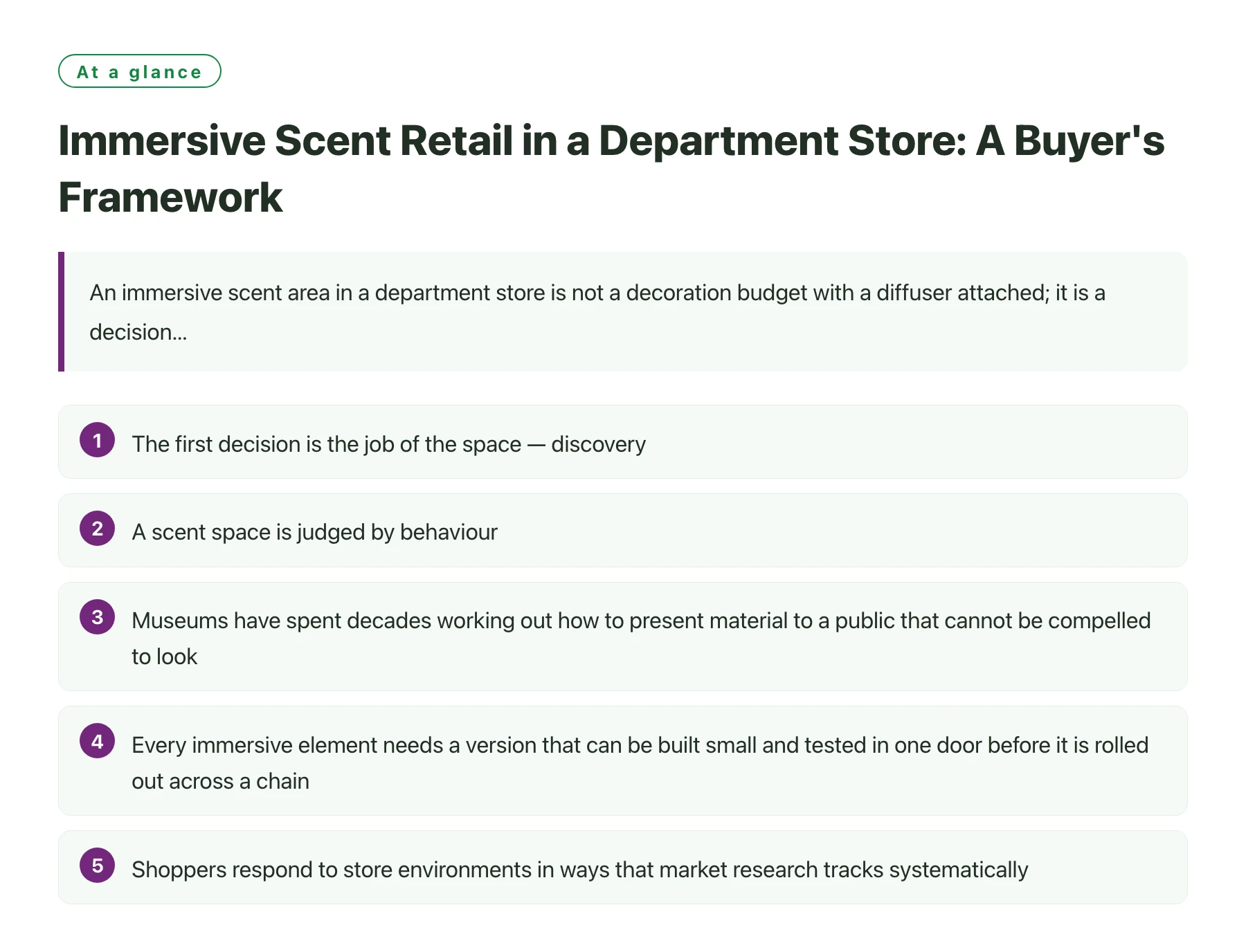
- The first decision is the job of the space — discovery, gifting, replenishment or brand theatre — because each job requires a different footprint, staffing level and measurement.
- A scent space is judged by behaviour, not by aesthetics: dwell time, how many shoppers pick up a tester, and how many return are the signals that matter.
- Museums have spent decades working out how to present material to a public that cannot be compelled to look, and their approach to interpretation transfers well to a retail floor [1].
- Every immersive element needs a version that can be built small and tested in one door before it is rolled out across a chain, or the project is a bet rather than a plan.
- Shoppers respond to store environments in ways that market research tracks systematically, which means the assumptions in a concept can be checked against published work rather than argued about internally [3].
Fragrance is difficult to sell at a distance. A shopper can see a bottle, read a name and recognise a brand, but the product itself only exists once it is smelled, and smelling is a slow, private act in a public space. That is the problem an immersive scent area is trying to solve, and it is why the format has spread from flagship stores into department store floors.
It is also why so many of these projects underperform. The concept is usually designed around what the space will look and feel like, while the commercial case rests on what shoppers will do inside it. Those are different questions, and only the second one has a number attached.
This framework is written for the person who has to approve the spend: a retail marketing lead, a category buyer or a brand founder preparing a first department store launch. It is deliberately unimpressed by technology and deliberately interested in how the space earns its floor.
The decisions, and how to test each one cheaply
| Decision | What it changes for the shopper | How to test it before committing |
|---|---|---|
| What the space is for | Whether a shopper is invited to explore, to choose a gift quickly, or simply to refill a product they already know | Run the same counter for four weeks with three different scripts and compare pick-up rates |
| Where it sits on the floor | How much accidental traffic arrives and whether the shopper is already in a buying mood | Try a temporary table in two locations before any fixture is manufactured |
| How the scent is presented | Whether a shopper can smell at their own pace or feels watched and moves on | Compare blotter-led sampling with guided sampling on the same counter, on alternating days |
| How many scents at once | Whether the range reads as a considered collection or as an undifferentiated wall | Reduce the visible set by half for a fortnight and watch what happens to the sell-through of the remaining products |
| How staff are involved | Whether the space is self-explanatory or depends on an expert being present at the right moment | Track conversion during staffed and unstaffed hours on the same fixture |
| What the sensory layer adds | Whether ambience, sound and lighting support discovery or compete with the product | Turn the sensory layer off for a week and compare dwell time and sampling |
| How success is measured | Whether the project can be defended at the next budget review or becomes a one-off | Agree two or three behavioural measures in advance, and record them before the space opens |
Every row in that table can be tested at a fraction of the cost of a built environment, and each test produces a number rather than an opinion.
What museums already know about presenting scent
Museums are the closest professional analogue to an immersive retail space, because they also invite a voluntary public to engage with something they cannot be required to notice. Museum practice has developed around interpretation — helping a visitor understand what they are experiencing without instructing them — and that discipline transfers directly to a counter where a shopper has to work out what to do.
Museum associations publish and debate guidance on how public programmes are built and evaluated, and the recurring themes are instructive: clarity about what a display is for, honesty about what it can and cannot show, and an interest in the visitor's actual behaviour rather than their stated intentions [2]. None of that requires a retail team to become curators, but it does argue against treating the space as pure atmosphere.
Borrowing the method, not the mood
The transferable part of museum practice is the sequence: decide the message, choose the objects that carry it, then design the path a visitor takes through them. Applied to a department store floor, that means choosing which fragrances introduce the brand, which ones carry the story, and which ones are there for the shopper who already knows what they want. A brand that has built a scent collection, or that operates a Guangzhou scent museum such as the one Xuelei describes as the world's largest, has usually worked through that sequencing problem already, and the reasoning is worth asking about rather than the imagery [1].
The part that does not transfer is the absence of commercial pressure. A museum can afford a visitor who leaves without buying. A counter cannot, which is why the retail version has to be tested against behaviour from the first week.
Staff, scripts and the training question
Most immersive concepts fail at the human interface rather than the physical one. A shopper who picks up a tester and gets nothing back learns that the space is scenery. The fix is unglamorous: a short script, a defined opening question, and enough product knowledge that the conversation can go somewhere. Structured professional scent training — the kind offered through a perfumery academy or an in-house programme — is often a better investment than a second display unit, because it improves every counter the brand already has [3].
It also gives the brand something to measure. If two teams are trained differently and their counters perform differently, the training programme has evidence behind it at the next budget round.
The commercial case, written before the concept
An immersive space has to be paid for from somewhere. The realistic sources are incremental sales of the range, improved sell-through of existing stock, better gifting attachment, and the value of the space as a marketing asset that reduces spend elsewhere. Only the first three appear in a store's sales data, and a proposal that cannot name which of them it is chasing will be approved or rejected on taste.
A useful discipline is to write the commercial case first, in one page, before any design work. The concept then has to serve it rather than the other way around, and the cheap tests in the table above become the natural next step instead of an afterthought.
Where brands over-invest
The most common over-investment is in technology that the shopper meets once. Interactive screens, scent-releasing triggers and synchronised lighting can all work, but they rarely carry the commercial case on their own, and they add maintenance to a floor that already has staff. The second is scale: building a full concept in several doors at once, which removes the chance to learn anything before the budget is committed.
Where brands under-invest
Two areas are habitually underfunded. The first is the tester experience — enough blotters, enough space to smell without crowding, and a place to put a used blotter down. The second is the follow-up: a shopper who discovers a scent in a department store and cannot find it online the same evening loses the thread. Discovery spaces and digital availability have to be planned together.
If the budget allows only one thing, fund the testing rather than the build. A temporary counter run in two locations for a month will tell a brand more about what a department store launch needs than any concept deck, and it costs a fraction of a permanent fixture. The natural next question is who can supply the range in a form that survives a pilot, which is where the scope of a contract manufacturer for perfume brands starts to matter, and where a partner with a museum of scent in Guangzhou can be asked to explain how a collection is sequenced rather than merely decorated.
Sources
- ICOM — International Council of Museums —— The international organisation representing museums; publishes the ICOM museum definition and professional standards for museum practice.
- Museums Association —— A professional body for museums, publishing guidance and research on museum practice and visitor experience.
- Mintel Press Centre —— Mintel's press releases on consumer and beauty market research, including fragrance and personal care trend reporting.
Frequently asked questions
What does an immersive scent space need to achieve to be worth the investment?
It has to change shopper behaviour in a measurable way, most often by increasing sampling, dwell time or gifting attachment. If the concept cannot name which of those it is targeting and how it will be measured before opening, it is being approved on aesthetics alone.
Should a brand build a full concept in every department store at once?
Rarely. A pilot in one or two locations, with the same fixture built temporarily, produces comparable data at a fraction of the cost and reduces the risk that a design flaw is repeated across a chain. Scale is much easier once the behavioural measures have moved in a pilot.
How important is staff training compared with the physical environment?
For most brands, more important than a second display. A shopper who is invited into a conversation samples more and remembers more, and training improves every counter the brand already operates. It also gives the brand a way to compare performance between teams.
What can a fragrance museum teach a retail team?
Mainly sequencing and interpretation: deciding what a visitor should encounter first, what carries the story, and how to make the experience legible without instructions. Museums have worked on that problem for a long time, and the method transfers even though the commercial pressure does not.
How does this connect to the fragrance supply chain?
A pilot still needs product that matches the concept, in packaging that suits a counter, often in small quantities. Choosing a manufacturer that can supply a limited first run without a heavy minimum, and then scale the same formula to a wider rollout, keeps the pilot and the expansion on the same formula.